
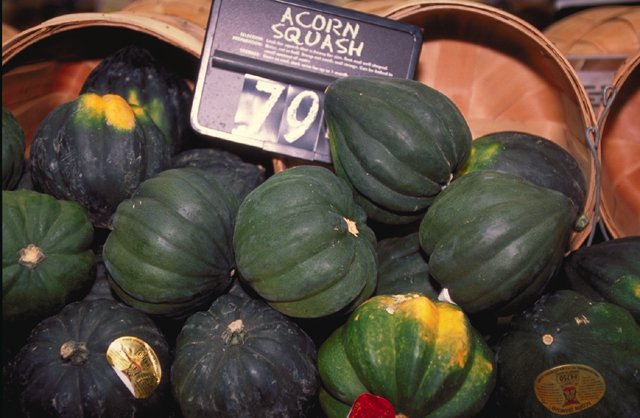
 Autumn harvest; suitable storage can extend availability into winter
Acorn Squash Nutrition Facts, Vitamins and Benefits
Acorn squash is a winter squash group recognized by its acorn-like shape and deeply ribbed skin. It can be roasted, stuffed or mashed. The nutrition table describes 100 g of raw edible flesh; the same values do not apply to seeds or peel eaten separately.
Acorn Squash benefits and place in a balanced diet
- A 100 g portion provides approximately 40 kcal; portion size and preparation affect total energy intake.
- Its approximately 87.8 g of water per 100 g contributes to total fluid intake.
- Its approximately 1.5 g of dietary fiber per 100 g contributes to fiber intake; a fiber-containing diet can support normal bowel function and fullness.
- About 11 mg of vitamin C per 100 g contributes to normal immune function, collagen formation and the absorption of iron from plant foods.
- About 18 µg RAE of vitamin A per 100 g contributes to normal vision, immune function and the maintenance of skin and mucous membranes.
- Its recorded folate content contributes to normal blood formation, cell division and homocysteine metabolism.
- About 0.154 mg of vitamin B6 per 100 g contributes to normal protein and glycogen metabolism, nervous-system function and red blood-cell formation.
- About 33 mg of calcium per 100 g contributes to the maintenance of normal bones and teeth, muscle function and nerve transmission.
- About 347 mg of potassium per 100 g contributes to normal muscle and nervous-system function and the maintenance of normal blood pressure.
- About 32 mg of magnesium per 100 g contributes to normal energy metabolism and muscle and nervous-system function.
- About 0.7 mg of iron per 100 g contributes to normal red-blood-cell and haemoglobin formation and oxygen transport. Absorption of plant iron varies with the meal.
- No single food prevents or treats disease. The nutritional value of acorn squash depends on portion size, variety, ripeness and the overall eating pattern.
Acorn Squash nutrition facts
The table covers calories, macronutrients, vitamins, minerals, fatty acids and amino acids where a measured value is available. Values are shown per 100 g and for a 100 g reference serving.
| Nutrient | Per 100 g | 100 g serving |
|---|---|---|
| Core values and macronutrients | ||
| Energy | 40 kcal | 40 kcal |
| Water | 87.8 g | 87.8 g |
| Protein | 0.8 g | 0.8 g |
| Total fat | 0.1 g | 0.1 g |
| Saturated fat | 0.021 g | 0.021 g |
| Monounsaturated fat | 0.007 g | 0.007 g |
| Polyunsaturated fat | 0.042 g | 0.042 g |
| Carbohydrate | 10.4 g | 10.4 g |
| Dietary fiber | 1.5 g | 1.5 g |
| Ash | 0.9 g | 0.9 g |
| Cholesterol | 0 mg | 0 mg |
| Minerals | ||
| Calcium | 33 mg | 33 mg |
| Iron | 0.7 mg | 0.7 mg |
| Magnesium | 32 mg | 32 mg |
| Phosphorus | 36 mg | 36 mg |
| Potassium | 347 mg | 347 mg |
| Sodium | 3 mg | 3 mg |
| Zinc | 0.13 mg | 0.13 mg |
| Copper | 0.065 mg | 0.065 mg |
| Manganese | 0.167 mg | 0.167 mg |
| Selenium | 0.5 µg | 0.5 µg |
| Vitamins and vitamin-like compounds | ||
| Vitamin C | 11 mg | 11 mg |
| Vitamin B1 (Thiamin) | 0.14 mg | 0.14 mg |
| Vitamin B2 (Riboflavin) | 0.01 mg | 0.01 mg |
| Vitamin B3 (Niacin) | 0.7 mg | 0.7 mg |
| Vitamin B5 (Pantothenic acid) | 0.4 mg | 0.4 mg |
| Vitamin B6 | 0.154 mg | 0.154 mg |
| Vitamin B9 (Folate) | 17 µg | 17 µg |
| Folic acid | 0 µg | 0 µg |
| Food folate | 17 µg | 17 µg |
| Folate, DFE | 17 µg DFE | 17 µg DFE |
| Vitamin B12 | 0 µg | 0 µg |
| Vitamin A | 18 µg RAE | 18 µg RAE |
| Retinol | 0 µg | 0 µg |
| Beta-carotene | 220 µg | 220 µg |
| Alpha-carotene | 0 µg | 0 µg |
| Beta-cryptoxanthin | 0 µg | 0 µg |
| Lycopene | 0 µg | 0 µg |
| Lutein + zeaxanthin | 38 µg | 38 µg |
| Vitamin D | 0 µg | 0 µg |
| Amino acids | ||
| Tryptophan | 0.011 g | 0.011 g |
| Threonine | 0.024 g | 0.024 g |
| Isoleucine | 0.031 g | 0.031 g |
| Leucine | 0.045 g | 0.045 g |
| Lysine | 0.029 g | 0.029 g |
| Methionine | 0.01 g | 0.01 g |
| Cystine | 0.007 g | 0.007 g |
| Phenylalanine | 0.031 g | 0.031 g |
| Tyrosine | 0.027 g | 0.027 g |
| Valine | 0.034 g | 0.034 g |
| Arginine | 0.044 g | 0.044 g |
| Histidine | 0.015 g | 0.015 g |
| Alanine | 0.033 g | 0.033 g |
| Aspartic acid | 0.086 g | 0.086 g |
| Glutamic acid | 0.14 g | 0.14 g |
| Glycine | 0.029 g | 0.029 g |
| Proline | 0.028 g | 0.028 g |
| Serine | 0.031 g | 0.031 g |
| Fatty-acid details | ||
| Trans fat | 0 g | 0 g |
| Linoleic acid | 0.016 g | 0.016 g |
How many calories are in Acorn Squash?
100 g (about 3.5 oz) provides approximately 40 kcal. A 100 g reference serving provides approximately 40 kcal. Values vary with variety, ripeness and preparation.
How to use Acorn Squash in the kitchen
Wash, carefully halve, remove the seeds and roast until tender, or cook into soup, puree or stuffed dishes. Do not confuse the raw reference weight with the weight of a cooked serving.
Related vegetables
Direct USDA records are used where available; closest-profile entries are explicitly labelled and remain approximate. Blank fields mean that the source did not report a value. General information only; not medical advice. Primary composition reference: USDA FoodData Central.