
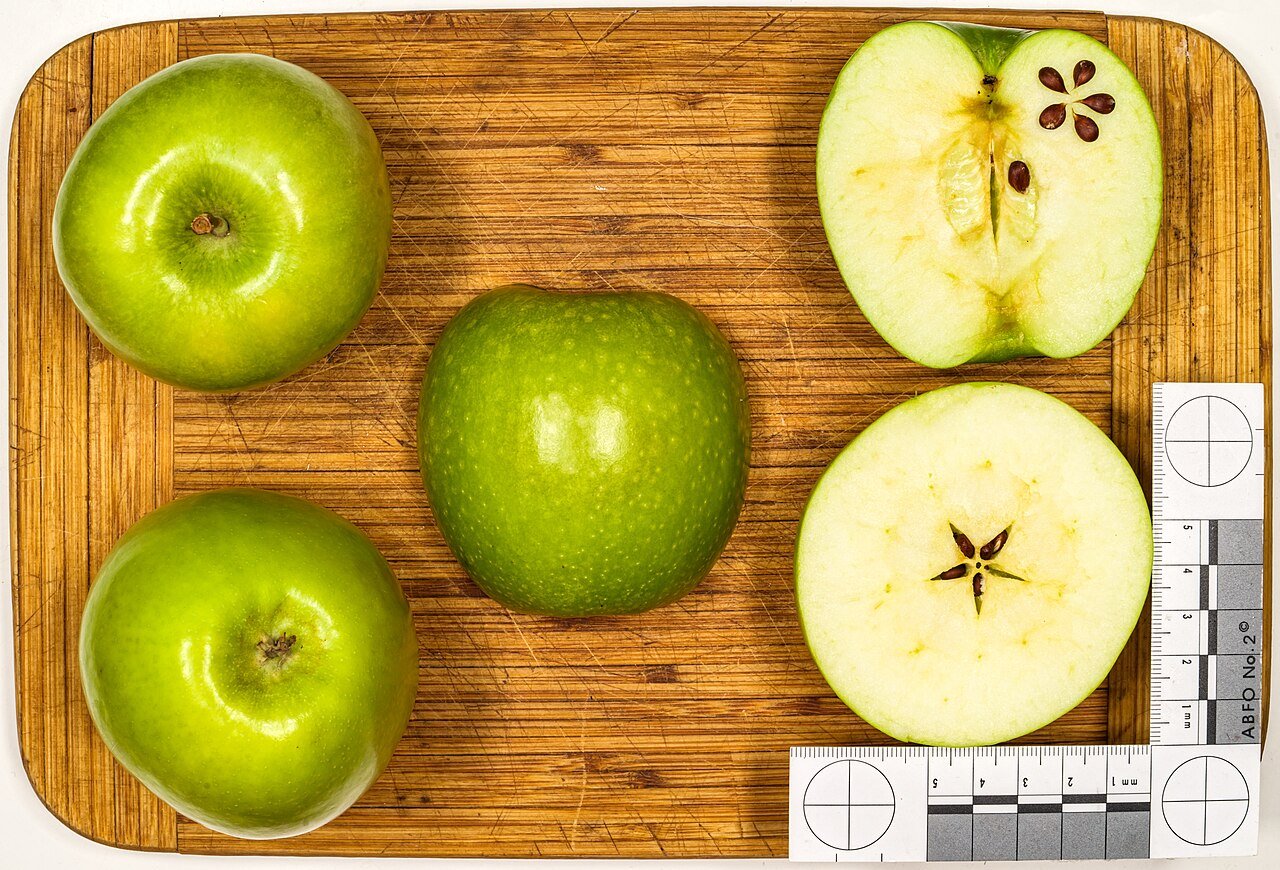
 Autumn harvest; storage and imports can extend availability year-round
Granny Smith Apple Nutrition Facts, Vitamins and Benefits
Granny Smith is an apple cultivar known for its green skin, distinctly tart flavor and crisp texture. It can be eaten fresh or used in salads and baked dishes where firmer slices are desirable. The nutrition table refers to 100 g of the edible, raw fruit with skin from this cultivar.
Granny Smith Apple benefits and place in a balanced diet
- A 100 g portion provides approximately 58 kcal; portion size and preparation affect total energy intake.
- Its approximately 85.5 g of water per 100 g contributes to total fluid intake.
- Its approximately 2.8 g of dietary fiber per 100 g contributes to fiber intake; a fiber-containing diet can support normal bowel function and fullness.
- About 3.2 µg of vitamin K per 100 g contributes to normal blood clotting and the maintenance of normal bones.
- About 0.025 mg of vitamin B2 per 100 g contributes to normal energy metabolism and the protection of cells from oxidative stress.
- About 0.126 mg of vitamin B3 (niacin) per 100 g contributes to normal energy metabolism, nervous-system function and the maintenance of normal skin.
- About 3.4 mg of choline per 100 g contributes to normal lipid metabolism, homocysteine metabolism and the maintenance of normal liver function.
- About 5 mg of calcium per 100 g contributes to the maintenance of normal bones and teeth, muscle function and nerve transmission.
- About 120 mg of potassium per 100 g contributes to normal muscle and nervous-system function and the maintenance of normal blood pressure.
- About 5 mg of magnesium per 100 g contributes to normal energy metabolism and muscle and nervous-system function.
- About 12 mg of phosphorus per 100 g contributes to normal energy metabolism and the maintenance of normal bones and teeth.
- No single food prevents or treats disease. The nutritional value of granny smith apple depends on portion size, variety, ripeness and the overall eating pattern.
Granny Smith Apple nutrition facts
The table covers calories, macronutrients, vitamins, minerals, fatty acids and amino acids where a measured value is available. Values are shown per 100 g and for a 100 g reference serving.
| Nutrient | Per 100 g | 100 g serving |
|---|---|---|
| Core values and macronutrients | ||
| Energy | 58 kcal | 58 kcal |
| Water | 85.5 g | 85.5 g |
| Protein | 0.44 g | 0.44 g |
| Total fat | 0.19 g | 0.19 g |
| Carbohydrate | 13.6 g | 13.6 g |
| Dietary fiber | 2.8 g | 2.8 g |
| Total sugars | 9.6 g | 9.6 g |
| Starch | 0.05 g | 0.05 g |
| Ash | 0.29 g | 0.29 g |
| Minerals | ||
| Calcium | 5 mg | 5 mg |
| Iron | 0.15 mg | 0.15 mg |
| Magnesium | 5 mg | 5 mg |
| Phosphorus | 12 mg | 12 mg |
| Potassium | 120 mg | 120 mg |
| Sodium | 1 mg | 1 mg |
| Zinc | 0.04 mg | 0.04 mg |
| Copper | 0.031 mg | 0.031 mg |
| Manganese | 0.044 mg | 0.044 mg |
| Selenium | 0.1 µg | 0.1 µg |
| Vitamins and vitamin-like compounds | ||
| Vitamin B1 (Thiamin) | 0.019 mg | 0.019 mg |
| Vitamin B2 (Riboflavin) | 0.025 mg | 0.025 mg |
| Vitamin B3 (Niacin) | 0.126 mg | 0.126 mg |
| Vitamin B5 (Pantothenic acid) | 0.056 mg | 0.056 mg |
| Vitamin B6 | 0.037 mg | 0.037 mg |
| Vitamin B9 (Folate) | 3 µg | 3 µg |
| Food folate | 3 µg | 3 µg |
| Choline | 3.4 mg | 3.4 mg |
| Vitamin A | 5 µg RAE | 5 µg RAE |
| Beta-carotene | 59 µg | 59 µg |
| Alpha-carotene | 0 µg | 0 µg |
| Beta-cryptoxanthin | 2 µg | 2 µg |
| Lycopene | 0 µg | 0 µg |
| Lutein + zeaxanthin | 64 µg | 64 µg |
| Vitamin E | 0.18 mg | 0.18 mg |
| Vitamin K | 3.2 µg | 3.2 µg |
| Types of sugar | ||
| Sucrose | 1.9 g | 1.9 g |
| Glucose | 2.7 g | 2.7 g |
| Fructose | 5 g | 5 g |
| Lactose | 0 g | 0 g |
| Maltose | 0 g | 0 g |
| Vitamin details | ||
| Vitamin K1 (Phylloquinone) | 3.2 µg | 3.2 µg |
| Fatty-acid details | ||
| Trans fat | 0 g | 0 g |
How many calories are in Granny Smith Apple?
100 g (about 3.5 oz) provides approximately 58 kcal. A 100 g reference serving provides approximately 58 kcal. Values vary with variety, ripeness and preparation.
How to use Granny Smith Apple in the kitchen
Slice with the skin for oats, yogurt and salads, or bake and simmer into compote. Added sugar and fat change the energy value.
Related fruits


Direct USDA records are used where available; closest-profile entries are explicitly labelled and remain approximate. Blank fields mean that the source did not report a value. General information only; not medical advice. Primary composition reference: USDA FoodData Central.